
Extinction Rebellion has just released a document /booklet about preparing for climate change adaptation.
My initial overview is that they covered a lot, but not in enough detail, and ignored how the preparedness movement has evolved beyond older approaches and trends among “preppers”. Let’s be honest about this: This is lefty prepping trying to emulate fascist prepping, and we can do so much better.
This is a comprehensive document, but it needs a lot more work. It lacks the detail required to make it a little more than a framework. Some of the advice is very limited in its scope, more because of the limitations of the Author (s). There is no evidence presented that anyone writing the XReadiness has any more skill than a weekend camper.
The opening section talks about “Go-Bags”, which is from the age-old “Bugging-out” fantasy when disaster strikes. You have a bag ready, and you run for the high ground and live out of what is in the bag for a few days. This assumes you have a chosen location to do that and can assume that 100s of other people aren’t going to do that too in the same location! The bugging out myth has been largely discredited. Few people actually have the skills, knowledge and experience to live off the land, especially if you are impeded by children, an inexperienced and frightened spouse/partner or have elderly people with you. The sensible way to temporarily evacuate is to go to a hotel or a friend’s place to avoid a storm or risk of flooding. But Random High ground in the countryside is the absolute last resort, should be for less than 24 hours unless there is a shelter like a Bothy.
You can only be as quick as your vehicle and the flow, or not, of traffic. A bicycle & trailer are only as good as being able to get through the traffic. On foot, you can only go as fast as the slowest evacuee. Are you really going to take your pregnant wife, toddler, dog, cat, and mother? Of course you are. But how many km on foot?
XReadiness demands expert-level skills in a document intended for beginners and novices; the best thing you can do with XReadiness is ignore it, don’t waste paper printing it. XReadiness falls foul of the myth that you can learn survival skills as you try to survive.
“Go Bags” are for highly skilled operators. People like Paul Kirtley, Ray Mears, Les Stroud, the late Tom Brown, the late Les Hiddins “Bush Tucker Man”, and many other accomplished survivalists and primitive skills practitioners. But ultimately, as practitioners’ skills improve, bag contents diminish. “Bugging Out” has been widely acknowledged among American survivalists to be mostly unworkable, but has not yet filtered through to Britain, and the prepper community in the UK still entertains fantasies of living off the land post-collapse. Compared to the US, Britain has virtually no wilderness to hide in. To live off the land in the UK, you need exceptional skills.
Anyone who thinks they can do “survival” should watch this video. This is what happens when you think you can learn survival skills while trying to survive. Tragically, the Vance family thought they could survive a Colorado winter on instant noodles, in nylon tents with no sanitation and relying on Lifestraws for water. Their camp was an appalling mess, and they died from malnutrition and hypothermia. XReadiness would not have rendered their outcome any better had they taken it.
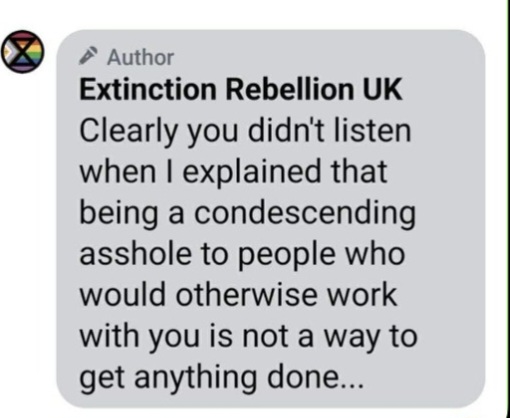
My original critique of the XReadiness approach was not as comprehensive as this post. This is the Full Monty: I messaged Extinction Rebellion on Facebook and tried to have a conversation about how dangerous and poorly thought-through XReadiness was, but they weren’t interested. In fact, they went on to send me this.
Whoever authored XReadiness should be forced to bug out, with the GO Bag, for 48 hours during a heatwave or severe downpour. Survivalists put themselves through paced tests to test their skills. Some of us have even done extreme initiations, which have involved fasting without water for 4 days.
Claire Farrel, in a discussion about the looming food crisis, asked whether anyone had gone on a hunger strike. She went on to talk about the panic you experience. 4 days without water takes you to the edge of death; the panic is palpable. XReadiness is clearly written by people who have never lived off-grid, let alone actually done any of the skills they talk about. Of course, responses like this just reveal the fragility of being wrong and caught out trying to fake expertise.
XReadiness chose to rewrite a government civil survival manual from Norway. The UK’s 2026 June Heatwave broke temperatures of over 39°C. Norway has never exceeded 34°C. They fail to identify that humid heat is more dangerous than dry heat. They fail to mention what wet bulb temperatures are, and how they kill. XReadiness is a “death from exposure trap”. Most people who decide to bug out with XReadiness kit will not be experienced enough to see that its a bad idea.
“Health, 1st Aid & Sanitation
Climate-induced health risks: heat stroke, hypothermia, etc.
The human body is sensitive to temperature extremes. Climate events increase the risk of heat stroke, dehydration, and hypothermia.
Learn to recognise early signs: confusion, dizziness, shallow breathing, or shivering can signal life-threatening conditions. Have a plan for the elderly, infants, chronically ill, and those without stable housing. In hot weather, stay hydrated, rest often, and cool the body with water or ventilation; in cold, insulate both body and shelter.”
The Above paragraph is waffle, pointless non-advice: Hypothermia and Hyperthermia are 2 different physiological responses to disregulation of heat and cold. The XReadiness Go Bag could induce either, depending on the climatic conditions, when you bug out, minus a tarp shelter, ground mat, and sleeping bag. The above paragraph is telling you to learn 1st aid, but most first aid at work courses don’t cover hyperthermia or hypothermia unless you are doing a Search and Rescue (SAR) Qualification. Vague 1st Aid advice is dangerous too.
“Sanitation & hygiene in resource-scarce conditions
Without running water or functioning sewage systems, hygiene becomes both a health and dignity issue.
Stock wet wipes, disinfectants, and trash bags for short-term sanitation. Create emergency toilet systems using buckets, composting setups, or dig pits well away from water sources.”
Wet wipes, once used, are full of microplastics.
Dr Gail Bradbrook was exclaiming in a video where she started fantasising about collapse, “We need the Guys who build stuff”, like off-grid showers, compost toilets, solar energy generating systems, wind turbine generators from rubbish, yeah, she meant those people. I have no doubt that whoever writes this XReadiness nonsense goes to the Big Green Gathering and never asks the right questions, like: what do I need to learn?
What would you rather have, off-grid showers or wet wipes?
Compost Toilets are the radical grid-down solution to sanitation. If sewage systems freeze in a post-AMOC collapse winter, or if power failures mean sewage isn’t pumped away, then dry sanitation units like this can be rat-proof.
There are radical new ways to plan for collapse:
Famine gardening with native staples. This is not beyond the scope of Permaculture. This practice combines foraged staples with growing them in marginal areas in your garden or as ground cover in flower beds, as well as guerrilla gardening them into nature around you, especially into corners of marginal land and wasteland. You are growing plants not commonly thought of as food in plain sight.
If you intend on printing XReadiness, you can use it as tinder. There’s enough information on planning for collapse on this blog and on the videos I put up on my YouTube Channels and:
Based on reports from Kollapscamp and some wider reading, I’ve identified five “elements” that go into the practice of being prepared—as a community—for disruptions in the systems that we usually rely on:
Emergency Preparedness:
Learning skills, collecting supplies, and making plans.
Community Networking: Finding and participating in existing local networks.
Mutual Aid: Acting in concert for the material benefit of other people.
Disaster Relief: Responding to catastrophic events with Mutual Aid.
Self-defense: Protecting our community from its enemies.
Each of these builds upon the other. We start by giving ourselves capability with preparedness in the home. We reach out into the community to discover the connections that already exist. Participating in those connections, we are able to distribute material aid to those in need. If disaster strikes, we have existing networks and procedures to respond. And the communal cohesion we build up over time gives us strength to defend our well-being if we are attacked.
 Solidarity Prepping: Preparing For Climate Change